Plan B

Last week while waiting in line for former President Jimmy Carter for a book signing, I met Rachel, Eddie, and Aisha. They were in front of me in line at 7:15 a.m. on a sunny July morning. The three of them, all 12 years old, are students in the High Jump Chicago program, an enrichment program for Chicago public school students with academic potential but limited economic means. They attend all summer and on Saturdays during the school year, for two years. The three, along with assorted family members, got up very early in the morning to make it from their cozy beds to a sidewalk in front of the Seminary Co-op Bookstore in Chicago’s Hyde Park neighborhood. The Secret Service needed to see the press at 7:30 in the morning as part of their security check of the premises, conducted four-and-a-half-hours before Carter arrived.

The press included these three students, dressed in distinctive blue T-shirts from High Jump, who prepared questions to interview Carter. To develop their questions, they had researched Carter and his time at the White House. Rachel knew, for example, that Carter was the first president to have installed a solar panel on the White House. Aisha had a more personal and disarming question: she intended to ask Carter what world problems kept him awake at night.

This summer field trip almost unraveled when the students and their Issues and Ideas teacher, Jill, were informed that Carter did not plan to take any questions. There followed discussion, some wheedling and pressing, retrenching. Well, I offered, this is part of a journalist’s lot: things don’t always go as planned. Write about what happens, regardless. That’s plan B.

The students retreated to the store’s Plein Air Café, since there were hours to go before Carter arrived. A compromise emerged: they were first in line when Carter arrived very punctually for his noon signing. By then the line stretched out the bookstore door and south down Woodlawn Avenue.

As it turned out, Carter did respond to questions. The 90-year-old former president is working on another book; pessimistic about prospects for Middle East peace (remember he won the Nobel Peace Prize in 2002 for his peacemaking efforts through his Carter Center); and thinks of Donald Trump as a gift to Democrats. The three middle-schoolers were at the head of a line of about 600 people.
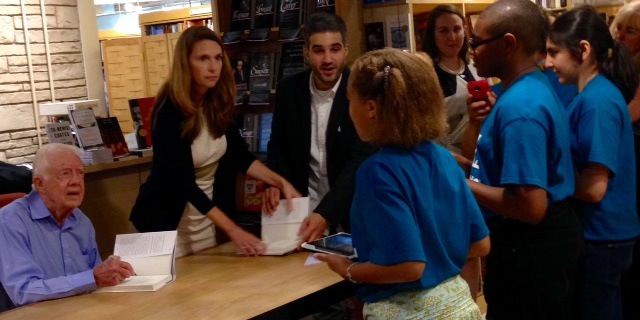
Image 2

This is my Plan B. I wrote it since my photo didn’t get used. But I also wrote it because it was an exhilarating day that reminded me of how much fun it is to listen to people’s stories, especially those people standing in line. Thanks, Rachel, Eddie, and Aisha. I hope you got a story too. My final advice: It pays to get up early sometimes.

Meditation: Lobstah Land

To my prairie-formed Midwestern eyes, Maine looks like nothing else I’ve seen: big water and hard granite. I come from the land of lake and limestone, where one watches for deer darting across the road, not massive moose that will best your car in a collision. The water around the island of Vinalhaven, where I am visiting, is dotted by colorful, bobbing buoys that mark the location of lobster traps. It’s lobster (or lobstah, as Mainahs call it) roll time and the season for summer people, down east and midcoast or wherever it is I am, not at home but visiting someone at her home.

My friend’s family is as native to Vinalhaven as its granite. Her great-grandfather polished the granite columns on the library; she points them out to me, and later shows me the farm her grandfather sold during the Depression. It’s now owned by summer people from Boston. Some people have been here a long time; her family name helps her fit in to the community of year-round residents, which is smaller by a few thousand than the summer population. Everybody wants to be in Maine in summertime, especially those who live the rest of the year in hot cities elsewhere.

Image

It’s not easy to get there; you need to know the ferry schedule. And the weather might mean the ferry won’t run, so you need to be ready with a plan B. Your car might not fit on the boat, which is OK because there’s no place you need to drive. The commercial strip is a few blocks long, and then it’s trees and rocks and houses sprinkled in outlying areas.

Besides granite, water, and lobsters, it’s all neighbors. My friend knows the vendors at the farmers market; one apologizes for not recognizing her. Stops to chat with people she knows are frequent. It’s a small place: small means everybody is up in your business, but pretty discreetly so. They give you your space. They’re Yankees: self-reliant and industrious, respecters of privacy, but there if you need ’em.

The Harbor Gawker restaurant, celebrating 40 years, is for sale. It’s called that because as it was originally sited, before the street was re-engineered, customers could sit and gawk at the harbor. The tablecloths are red and white checkered oilcloth. The menu is neatly printed on chalkboard after chalkboard after chalkboard, listing a dizzying variety of ways to serve fish and shellfish and, of course, lobster. It’s known for generous servings. My lobster roll is so stuffed with hunks of mayonnaised crustacean that I eat it with gusto and deliberation, so none of it ends up in my lap.

Place: what you see, what you hear, what you eat, how people live. Foreign or familiar, offering roots yet changing. Work, food, ancestors, neighbors, weather, the horizon of history and rock and big water. Millions of permutations of home.