Melanie and Atticus

A number of animal residents of Richmond, Ind., have brightened my days when I am required to be here for residential study at the Earlham School of Religion. Two of them have been Melanie and Atticus, a pair of dogs whom I met a few years ago on their regular walk down the alley that adjoins my guesthouse. Their human companion is Neville (another story). Last night I met Neville walking only Atticus. Melanie is gone; Neville explained that she was 13 and had begun to experience health problems. Atticus is a robust 3-year-old, Labrador-sized (I don’t know his breed, since I am a cat person), whose disposition is visibly sweeter now that Melanie, the more sociable of the pair, is gone. Atticus nosed around patiently as Neville filled me in on the dogs.

dog-breeds

Though I rarely see these dogs, I was stricken by a pang of sadness. A dog’s, or any pet’s, death gives us humans an inkling of the big snooze that awaits us. I am picturing Melanie in the Elysian Fields, happily sniffing around, attracting friendly attention from many souls. The Gospel of John, which has my attention during my study here, contains the immortal image of the good shepherd. Dogs are used to help with shepherding. Some would say Melanie has been promoted to a happier neighborhood, where she doesn’t have to wait for Neville to walk her, I expect. For some sentient beings, heaven is a dog park. Here on earth, Atticus continues dog duties and doings, which include nosy visiting with strangers who may become friends.

Mr. Fish, in memoriam

Mr. Fish, the piscine member of our household, died this morning at the age of 19. We are guessing his age. He joined us sometime between 1994 and 1997, the years Bill was in nursing school. That’s as close as we can come.

He was a really old goldfish, and sizeable as well, four inches or so from tip to wavy tail.His orange-

FullSizeRender

Junior, subbing for the late Mr. Fish

gold color had almost entirely worn off, and he had been blind for quite some time. A fishy cataract covered one of his eyes. The other eye was diseased; it was tumorous-looking and swollen, probably a xenoma, a lumpy growth caused by a parasite.

Mr. Fish didn’t seem bothered by his tumor or lack of vision; he knew where he was. He hung out in one corner of his aquarium and ate his meals every day. For the past few years we were expecting every morning to find him floating on the water’s surface. This expectation was gradually overtaken by amazement at his longevity. I took to calling him Methusaleh. He reminded me of Granddad, the Australian lungfish at the Shedd Aquarium, whom I was introduced to years ago when writing a story. Granddad came to the Shedd in 1933; it is unclear how old he was when he arrived.

Mr. Fish was the last surviving member of a gang of feeder fish we acquired sometime after we moved to Aurora in 1994. Feeder fish are destined to be consumed by larger fish-eating animals. We liberated a dozen of them to spend their time with us in our vegetarian household instead. Over time, they died, one by one, except Mr. Fish, who swam along, slowly and persistently enlarging himself and his territory.

Old fish don’t do a whole lot less than young fish. Yet Mr. Fish got a new lease on life in November when we brought the new goldfish Junior from the pond on the deck indoors for the winter. We were slightly apprehensive that Junior might be the death of the aged resident fish, but something wonderful happened instead.

They made friends. Mr. Fish swam more. They hung out together in the same corner of the aquarium. Mr. Fish appeared to be teaching Junior the secret of indoor survive-and-thrive. The two could frequently be found side-by-side.

Until this morning. Right now I can see Junior, checking and re-checking their common corner, his tail wriggling. Where’s the old man?

Though James Herriot popularized it, the phrase “all creatures great and small” comes from a poem by the Irish hymn-writer and poet Cecil Frances Alexander. Every being deserves a little notice. Here is your obit, Mr. Fish. Peace be to you.

Catching Up on Reading

Did anybody but me wonder about the literary references in Jonathan Franzen’s Purity? I am resisting googling the reviews (except for PW). The Dickens reference to Great Expectations is explicit, but I found myself thinking about the way the murder is written and the kind of fever dream that Andreas Wolf’s mind eventually becomes, and thought of Dostoyevsky’s Crime and Punishment,  given how much force the murder assumes over time, given how deeply it is buried (pun intended). The querying of ideological purity also called to mind Jean-Paul Sartre’s play Dirty Hands, which perhaps really dates me or at least says something abut the literature and philosophy I was taught.

I hated the characters so much I almost didn’t finish the book. But it did keep hooking me, even though I would have shortened it. Tom’s and Andreas’s back stories are too long and tediously male-centric; Franzen’s editor ought to stand up to him a little more. Still, I am glad I read it to continue reckoning with the reaches of contemporary tastes and forms. Such a sea of difference between literary fiction and genre fiction.

God’s Hands

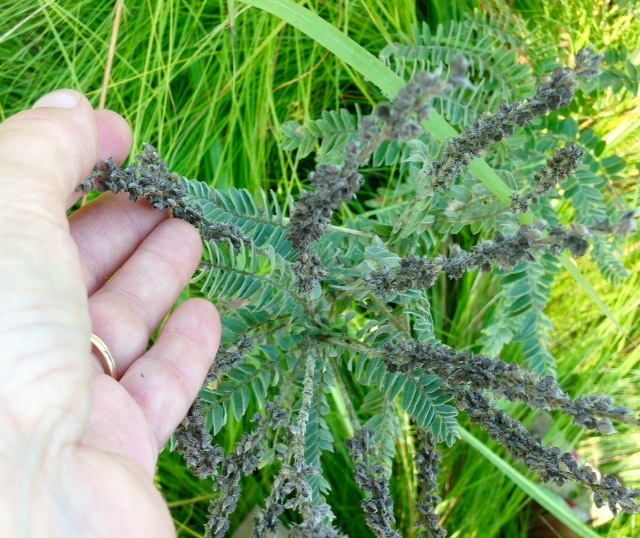
I haven’t had a chance to reflect on seed collecting as being God’s hands. Christ has no body, no hands but yours, wrote Teresa of Avila. Last Tuesday I dove into tallgrass prairie, leaving the path and heading into the grasses, seeking leadplant. Our steward Cindy has told us that the presence of leadplant is a sign of eco-health, and the Schulenberg Prairie is a vigorous being this year, bursting with leadplant. If the earth is God’s body, what organ are the prairies? The kidneys, maybe, filtering waste products?Image

Leadplant was pretty in bloom, with purple lupine-like flowers (the two are cousins, both members of the bean family) and fuzzy leaves. The dried flowerheads are easy to spot, of middling height next to tallgrass. It’s also easy to collect seeds, stripping them easily and then feeling like I could pat the plant as I might a just-sheared sheep, saying thanks and go on now. We only take half the seeds and leave the other half to reseed the prairie on its own. The week before I did coneflowers, and those were just as easy but differently textured, pointed seeds bordering on prickly and so needing clipping of the seedheads. Leadplant by comparison is gentle on the hands.

At the end of long summer days on the prairie, dried forbs mix with early autumn plants in bloom: purply-blue asters, cream gentian (I haven’t seen the blue variety). Many of the varied yellow composites are still hanging around, but the blooms of summer are aging into seedy maturity, losing eye-candy appeal and settling into the rhythm and imperative of reproduction. The yellow coneflower ages well, drying into drooping grey florets but gaining olfactory appeal with its anise-smelling seedhead, so many individual seeds tightly packed, poised to parachute to earth, take hold, and flower next year.

“There are no women on my theology bookshelf…”

Now you all have no excuse, thanks to Maggi Dawn.

maggi dawn's avatarmaggi dawn

Last year on Twitter, someone wrote to me “there are no women on my theology bookshelf. Who should I read?”.

I followed up with a blog list, and was pleased to discover that without even looking up from my screen I could easily think of well over a hundred female theologians, ecclesiastical historians, biblical scholars, sociologists of religion, and others who figure on the theological landscape. More names appeared when I actually looked at my own bookshelf.

Replies flooded in through the comments, adding many more names of women authors – both academic and devotional, theoretical and practical, in every area of the theological landscape. Now the academic year is about to begin again, one or two people have mentioned the post again as a resource – so, incomplete though it is, here is the updated blog post with names added from the comments section.

10897776_469733266514841_7639664988515007378_nWhen people ask about “women…

View original post 2,259 more words

Meditation: Lobstah Land

To my prairie-formed Midwestern eyes, Maine looks like nothing else I’ve seen: big water and hard granite. I come from the land of lake and limestone, where one watches for deer darting across the road, not massive moose that will best your car in a collision. The water around the island of Vinalhaven, where I am visiting, is dotted by colorful, bobbing buoys that mark the location of lobster traps. It’s lobster (or lobstah, as Mainahs call it) roll time and the season for summer people, down east and midcoast or wherever it is I am, not at home but visiting someone at her home.

My friend’s family is as native to Vinalhaven as its granite. Her great-grandfather polished the granite columns on the library; she points them out to me, and later shows me the farm her grandfather sold during the Depression. It’s now owned by summer people from Boston. Some people have been here a long time; her family name helps her fit in to the community of year-round residents, which is smaller by a few thousand than the summer population. Everybody wants to be in Maine in summertime, especially those who live the rest of the year in hot cities elsewhere.

Image

It’s not easy to get there; you need to know the ferry schedule. And the weather might mean the ferry won’t run, so you need to be ready with a plan B. Your car might not fit on the boat, which is OK because there’s no place you need to drive. The commercial strip is a few blocks long, and then it’s trees and rocks and houses sprinkled in outlying areas.

Besides granite, water, and lobsters, it’s all neighbors. My friend knows the vendors at the farmers market; one apologizes for not recognizing her. Stops to chat with people she knows are frequent. It’s a small place: small means everybody is up in your business, but pretty discreetly so. They give you your space. They’re Yankees: self-reliant and industrious, respecters of privacy, but there if you need ’em.

The Harbor Gawker restaurant, celebrating 40 years, is for sale. It’s called that because as it was originally sited, before the street was re-engineered, customers could sit and gawk at the harbor. The tablecloths are red and white checkered oilcloth. The menu is neatly printed on chalkboard after chalkboard after chalkboard, listing a dizzying variety of ways to serve fish and shellfish and, of course, lobster. It’s known for generous servings. My lobster roll is so stuffed with hunks of mayonnaised crustacean that I eat it with gusto and deliberation, so none of it ends up in my lap.

Place: what you see, what you hear, what you eat, how people live. Foreign or familiar, offering roots yet changing. Work, food, ancestors, neighbors, weather, the horizon of history and rock and big water. Millions of permutations of home.

Lament

Both Ta-Nehisi Coates and Jon Stewart have spoken my mind on the murders in Charleston. I feel heavily the charge that white people need to speak more forcefully against racism. One thing I can do is use my particular gift of writing; I’m also privileged to be in seminary these days, wrestling with understanding the Bible. I know for sure: the Bible speaks about violence, understands violence, portrays it. Who needs Game of Thrones to understand exquisite cruelty, anger, revenge? The seeds of violence are in the human heart and it is a most persistent weed; it is evil in the garden.

The sin of racism has allowed this weed to flourish for centuries. When violence arms itself with guns, wraps itself with flags, seduces the cowardly or weak-minded, the result is lethal. There is lament in Charleston and throughout the land.

Do what you can. Those of us who are privileged cannot afford despair. Read, march, weep, pray. There are many prayers of anger and lament in the Bible:

Don’t kill them,

or my people might forget;

instead, by your power

shake them up and bring them down,

you who are our shield and my Lord.

For the sin of their mouths,

the words that they speak,

let them be captured in their pride.

For the curses and lies they repeat,

finish them off in anger;

finish them off until they are gone!

Then let it be known

to the ends of the earth

that God rules over Jacob.

Ps. 59: 11-1

No Fixing

“No fixing, saving, advising, or correcting each other.”

A Circle of Trust “Touchstone” at Parker Palmer’s Center for Courage and Renewal

I am always tempted. Tempted to fix, save, advise. Someone says something to me and I wonder: what is that person really saying underneath what she is saying? Is that person saying: I need you to fix this? Probably not. So why should advice come out? And yet it does.

Someone in my meeting sent me some queries with an open-ended request: what do you think? Well, it depends. My usual reaction is to think the situation depends on me: I have to fix/save/advise. What would happen if those responses were unnecessary? If I were only being asked to listen because someone needed to be heard?

On the surface listening would seem to be easier. Yet it can require holding back, not responding unless requested. In practice listening is harder than it appears. It’s not for the lazy or what the Buddhists might term “unskillful, ” a term meant to suggest that one needs to practice a skill, and practice makes one more better at it.

We who are Quakers get regular practice in listening. In our Meetings for Worship, we listen expectantly. We expect to hear something from the Spirit. That listening is hard. Spirit is invited, but cannot be dragged in. Making an effort is less successful than stopping effort and only noticing. The body is still but the mind is very active, thinking about fixing/saving/advising: Now that committee meeting didn’t go well. I should have said…

Listening is hard because we live in a noisy world and the insides of our heads reflect that. Sitting in silence we eliminate some noise, but not all. Sitting in silence means not eating mental junk food, reaching for a Flamin’ Hot bag of habits and distractions.

There are of course times when people need to be saved. But these should be obvious. An earthquake in Nepal has killed thousands of people. Those who were trapped needed to be saved. Nepal will need fixing for years to come. We who want to help need to be advised on how best to do so.

But when life offers not dreaded emergencies but blessed opportunities to connect with others and grow, are we listening expectantly? Or are our own ideas getting in the way, like false gods?

What if saying nothing were a gift to be given? Go ahead: I’m all ears. Oprah Winfrey, one of my favorite spiritual teachers, said pretty regularly: people just want to be heard. The Spirit, too, wants to be heard. Very occasionally, the Spirit shouts if you’ve really missed the message. But usually the Spirit speaks, or listens, through others or in a sudden tiny epiphany: a thank you or good job or isn’t that beautiful. Isn’t that beautiful doesn’t need correcting.
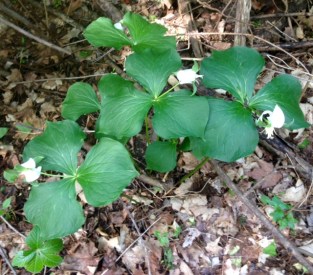
noddingtrillium

Listen for the epiphany. It’s on the other side of the anxiety, beyond the fixing and saving.

Queries: What do you hear when you listen?

Is there more than one kind of listening?

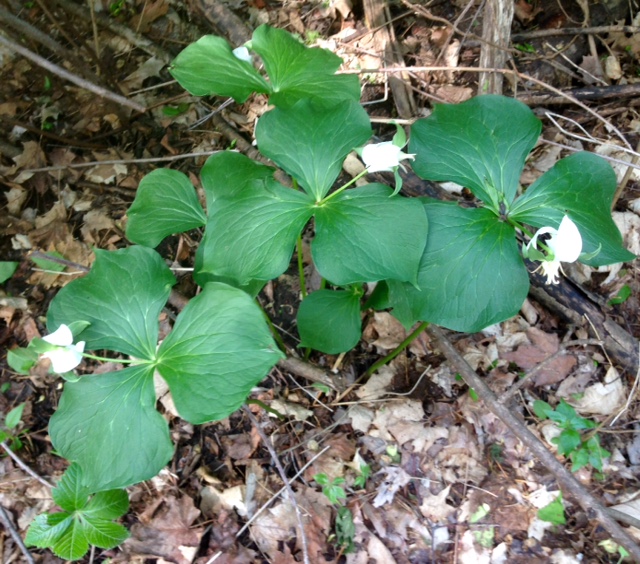
(Nodding trillium, depicted, lives in Hidden Lake Forest Preserve, which does need fixing.)

Thank You Prayer for Spring

Thank you for all the plants pushing new life out, green newborn nubs.

Image 2Thank you for the green grass of scilla, topped by delicate blue stars.

Thank you for the sunny yellow trumpets of daffodils.

Thank you for the fat buds of saucer magnolia, ready for their cue to open.

Thank you for the nodding white umbrellas of snowdrops.

Thank you for the heady perfume of hyacinths.

Thank you for the spiky yellow plumes of forsythia.

Thank you for the sweet song of the cardinal, birdie birdie whistled at treetop.

Thank you for the orange-breasted robins hopping hungrily on lawns.

Thank you for the brightening gold of goldfinches, swooping through the yard.

Thank you for the rabbits at dusk, munching the short new grass.

Thank you for the discreetly lengthening daylight, the temperature inching toward warmth, the surge of plant life tuning up for its return.